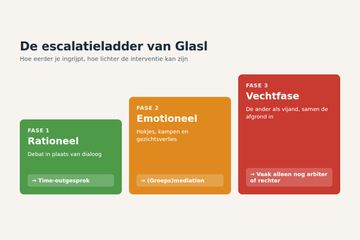
1. The Rational Phase
The parties are still communicating in a businesslike manner and working together to find a solution that benefits everyone. Yet the discussions are already becoming more tense: the language is getting harsher, arguments are being used to convince the other side, and the common interest is taking a back seat. An early sign is that a dialogue is turning into a debate, in which each side insists that it is right.
At this stage, a joint solution is still very much within reach, as long as people continue to listen to one another.
Appropriate intervention: the time-out conversation. This is an accessible and positive intervention for early signs of tension, misunderstandings, or communication problems, as long as those involved are still willing to talk to one another. It consists of two individual introductory conversations lasting up to 30 minutes each, a joint conversation lasting up to two hours, and a brief debriefing with advice on next steps. The result: restored communication, greater mutual understanding, concrete working agreements, and the prevention of escalation or absenteeism.
Would you like to request a time-out meeting? Send an email to [email protected] or call Gimd at 088 800 85 40. Are you a customer of ZekerArbo? Your dedicated customer team would be happy to help you.
2. The Emotional Phase
Now, emotions such as fear, anger, and sadness are driving behavior. People pigeonhole one another and talk about each other instead of with each other. They seek support from colleagues, which leads to the formation of factions within the team. Differences of opinion turn into hard-line, conflicting interests, and discrediting the other person becomes more important than finding a solution.
What helps here is focusing on reestablishing contact and acknowledging emotions.
Appropriate intervention: mediation. If the conflict has escalated further, mediation provides structure and a safe environment. An independent mediator facilitates a confidential process in which the parties retain ownership of the solution. Agreements can be documented in writing.
Sometimes an employee first needs a confidential conversation with someone outside their own chain of command. For this purpose, an external confidential advisor can be a solution.
3. The Fighting Phase
In the final stage, the focus is on winning—or defeating the other party—even if that comes at the expense of one’s own interests. The tone becomes confrontational; harsh demands and threats are made, and the other party is viewed as an enemy. At the final rungs of the ladder, mediation is often no longer an option, and the only recourse left is an arbitrator or a judge.
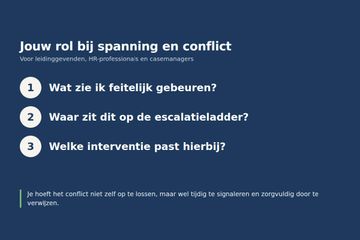
The lesson is clear: take action before this stage, because by this point the relationship is usually already severely damaged. The sooner you take action, the less drastic the intervention can be.
Are you unsure which stage a conflict is in? Talking it through helps. Contact Gimd for consultation and advice, or call ZekerArbo at 088 277 4444.