Skip to content

Navigating the December Rush Together: Here's How to Help Your Team Get Ahead.

Navigating the December Rush Together: Here's How to Help Your Team Get Ahead.

The last few weeks of the year are often the busiest. Here's how you can get through them together.

December. Clients want to get things sorted out quickly before the New Year. The year-end closing needs to be finalized. The calendar is filled with holiday parties and Christmas dinners. And at home, gifts, errands, and family are waiting. Both work and personal life are getting busier at the same time—just when it’s dark outside and energy levels are low.

For most people, it’s just a matter of hanging in there for a few weeks. But for those who are already running on fumes, December can be the last straw. As an employer, there’s a lot you can do about it—without launching major programs, just by making a few smart choices.

Navigating the December Rush Together: Here's How to Help Your Team Get Ahead.

Why December Is a Busy Month

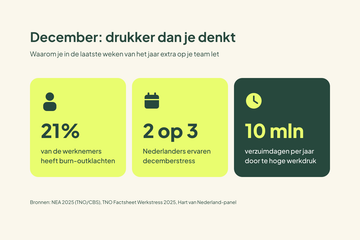
The situation is already dire. More than 1 in 5 employees in the Netherlands suffers from burnout symptoms: 20.7 percent in 2025. Ten years ago, that figure was about 13 percent. Among employees aged 25 to 34, the rate is as high as 28 percent. Do you have ten employees? Then, statistically speaking, two of them are suffering from burnout symptoms.

On top of that, there’s December. Nearly two out of three Dutch people experience some form of December stress. Heart rate variability measurements show that December is the most stressful month of the year. At the same time, we don’t recover as well at night. More stress, less recovery: that’s the combination you need to watch out for.

And that costs money. Excessive workloads led to 10.3 million days of absenteeism in the Netherlands in 2025. In 2023, employers paid 8.3 billion euros in wages due to work-related Sickness Absence. More than half of that was due to workloads and inappropriate behavior.

Recognize the signs

Burnout rarely starts with an absence due to illness. You can usually see it coming. Watch for these signs in your employees:

  • Changes in behavior. Someone may become irritated more easily, be quieter than usual, or withdraw.
  • More mistakes. Forgetting things, carelessness, deadlines that suddenly can't be met.
  • Long days. Emails at 11 p.m., no more breaks, days off that aren't taken.
  • Frequent short-term illnesses. A day here, a day there. Often a sign that you’re running out of steam.
  • Fatigue. Feeling tired at the start of the day, and still not recharged after the weekend.

Do you notice this in someone? If so, don't wait until January. A brief conversation now can often prevent months of downtime later on.

Here's How to Keep Your Team Going

You don't need to set up a big wellness program. With these six steps, you can make a difference as early as December:

  • Take a critical look at the schedule. What really needs to be finished by December 31? And what can easily wait until January? Push back whatever you can.
  • Ask how things are really going. Take a moment during the work meeting or over coffee. Don’t ask, “Everything okay?” but rather, “How are you holding up this month?”
  • Leave the evening alone. Don't send emails or text messages after work. Not even "just a quick one."
  • Encourage people to take a break outside. A walk during lunch provides fresh air and natural light. That’s especially valuable during the darker months.
  • Keep the get-together casual. Schedule it during work hours and don't make it mandatory. Not everyone has time for another night out in December.
  • Make sure that time off is truly time off. Agree on who will be available between Christmas and New Year's Eve. That way, the rest of you won't have to check in.

And as a business owner? Lead by example. If you’re still sending emails at 10 p.m., your team will take that as a signal—even if you say it’s not necessary.

Navigating the December Rush Together: Here's How to Help Your Team Get Ahead.

Do you notice when someone gets stuck?

Start a conversation, and above all, listen. Ask what’s going on, both at work and at home. Work together to see what changes can be made temporarily—fewer tasks, different work hours, or taking a step back for a while.

Can’t work it out together? Employees can always consult the company doctor, even if they aren’t sick (yet). A preventive consultation like this helps address symptoms early on. Be sure to actively inform your employees of this option.

Would you like to gain a better understanding of the workload in your company? ZekerArbo helps you with prevention, so that issues don’t escalate into Sickness Absence. hassle-free. Contact us →

End the year on a peaceful note

December doesn’t have to be a sprint to the finish. Delegate what you can, look out for one another, and make sure everyone can truly take time off. That way, your team will start January refreshed. And that’s good for your business, too.

Already a customer of ZekerArbo? Contact your account team. Not a customer yet? Visit zekerarbo.nl to learn how we help small and medium-sized business owners with Sickness Absence and prevention.

Sources

More articles

All posts